
What is Tai Chi Chaun? What do we teach...
- Open Door Five - Master Joe Lok
- Phoenix in Graceful Clouds of Blessing Form - Joe Lok
- Tai Chi For Health - Tai Chi For Arthritis & Fall Prevention/Tai Chi For Beginners/Tai Chi For Kidz
- Ba Duan Jin,
- 5 Elements,
- Yang 24 Form,
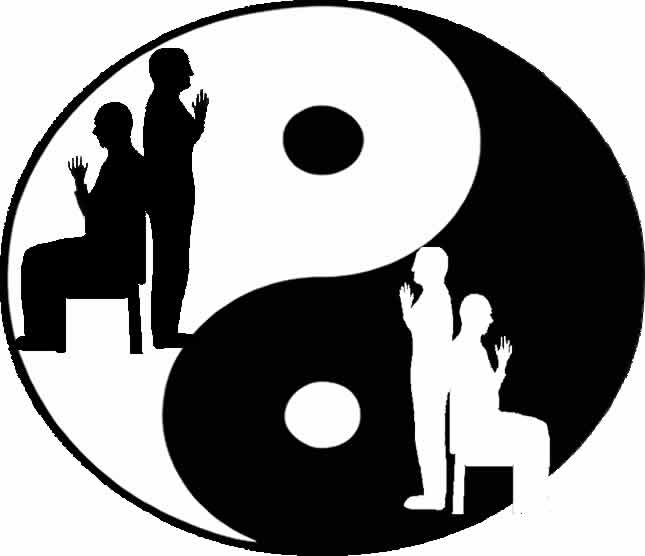
Please be aware, we refer to Tai Chi but it is in fact Tai Chi Chaun that we are teaching. Tai Chi Chaun is a Chinese martial art which also follows the Chinese philosophy of opposite forces represented by the Yin and yang symbol (also known as Tai Chi Diagram). Martial arts is designed to use the opposing forces, storing and delivering energy, expansion and contraction of movements both attack and defense.
What is Tai Chi Chaun? It is a series of choreographed slow soft flowing movements that have a participant always in a state of motion from the start to the end of a sequence. Each movement has its own name within the choreographed sequence of movements known as the form.
Tai Chi Chuan is an ancient Chinese internal martial art dating over 400 years, its exact origins are unknown and there are various stories. Who created Tai Chi Chuan is not conclusive or why, some say it was primarily a form of self-defence as China was a lawless society and others believe the monks needed a way to improve their physical ability to match their mental strength. It is inevitably a form of movement that both has martial applications for defence, but also improves health and stimulates the flow of energy 'chi'.
There are five original styles of Tai Chi Chuan and many variants, each named after the different families in China that developed them. The styles are Chen, Yang, Wu, Wu Hao and Sun. The differences between these styles are mainly the different paces, stances, weight distribution and movements employed in them. However, they all still have similar basic principles underlying them. These range from corresponding movement with either the inhalation or exhalation of a deep, gentle breath, aligning the posture, smooth continuous movement, pushing against resistance, maintaining mental awareness and focus, relaxing the joints and always moving from a point known as the Dan Tian, 3 finger widths below the navel. This coordination of movement and breath is believed to free the flow of “chi”, a life-force energy that when blocked, can cause stress and illness. By improving the link between a person’s mind and body, Tai Chi chuan re-establishes natural harmony.
Qigong is a traditional holistic health discipline that goes back at least 2000 years and can be translated as ‘internal energy work’. The moves are a wonderful method of relaxation and a gentle way to strengthen the mind and body. There may be centuries between the creation of Qigong and Tai Chi Chaun but both activities harness the "Chi", helping our life energy flow.
In Class we practice "Phoenix Qigong" which was created after careful examination of the practice of Tai Chi Chaun, Qigong and internal cultivation methods, Neidan.
My Sifu(Teacher) is Master Joe Wai Man Lok, from Hong Kong, and the creator and founder of “Phoenix in Graceful Clouds of Blessing” - Tai Chi Qigong exercises to circulate internal energy and promote holistic health for body and mind. Reduce stress, joints & muscles strengthened.
Regular practice of the Phoenix Qigong clears blockages, discards toxins, improves immunity, realigns joints, relieves pain and brings back balance of body and mind
The negative damage in daily life is patched up with positive energy leading to longevity
Master Joe Wai Man Lok, A 20th generation inheritor of the Dragon Gate Taoist tradition, a 27th generation Wudang San Feng Natural inheritor, master of Chinese internal martial arts.
To order Master Loks book: https://www.joelok.com/book
We are also qualified to teach several of Dr Paul Lam's Tai Chi for Health programs, including Yang 24. All forms of Tai Chi Chaun are good for your health, but what we particularly like about Dr Lam's programs is he has made them accessible to all. In his forms, he has removed the lower stances and high kicks that some forms have. He has developed forms that are quick to pick up and not as complex as some. It uses smooth gentle flowing movements designed to improve agility.
Furthermore, we run weapons workshops, introducing either the Fan form or Stick.
*Please note that Tai Chi Chaun, T’ai ji quan or Qigong, Chi Kung etc may be different spellings but they all refer to the same form of movement it simply depends on the system used to translate.